
On Tuesday morning, August 25, 2026, a Hollywood actor stepped off a plane at Entebbe International Airport wrapped in the Ugandan flag, grinning at a welcome party of traditional dancers who clearly weren’t there for just anyone.
That actor was Tyrese Gibson. Yes, the Fast & Furious one. Roman Pearce himself.
He wasn’t in the country to shoot a movie or headline a random concert. He was there because Uganda wanted to do something it doesn’t do often enough, put its coffee story in front of an audience that has never thought about Uganda and coffee in the same sentence.
Over three days in Kampala, Gibson’s visit centred on the launch of a new campaign called Explore Uganda Coffee Tourism, alongside a meeting at State House with President Museveni. By the time he left, he’d become the international face of a campaign trying to answer a much bigger question than “will a celebrity visit get us some headlines.” It’s trying to answer whether Uganda can stop selling coffee as a raw ingredient and start selling it as an experience, a brand, and a reason to travel.
Who Actually Invited Him, and Why
Gibson’s trip wasn’t a spontaneous detour. It was a coordinated visit at the invitation of the Government of Uganda and a group of private sector partners, built specifically around the launch of Explore Uganda Coffee Tourism.
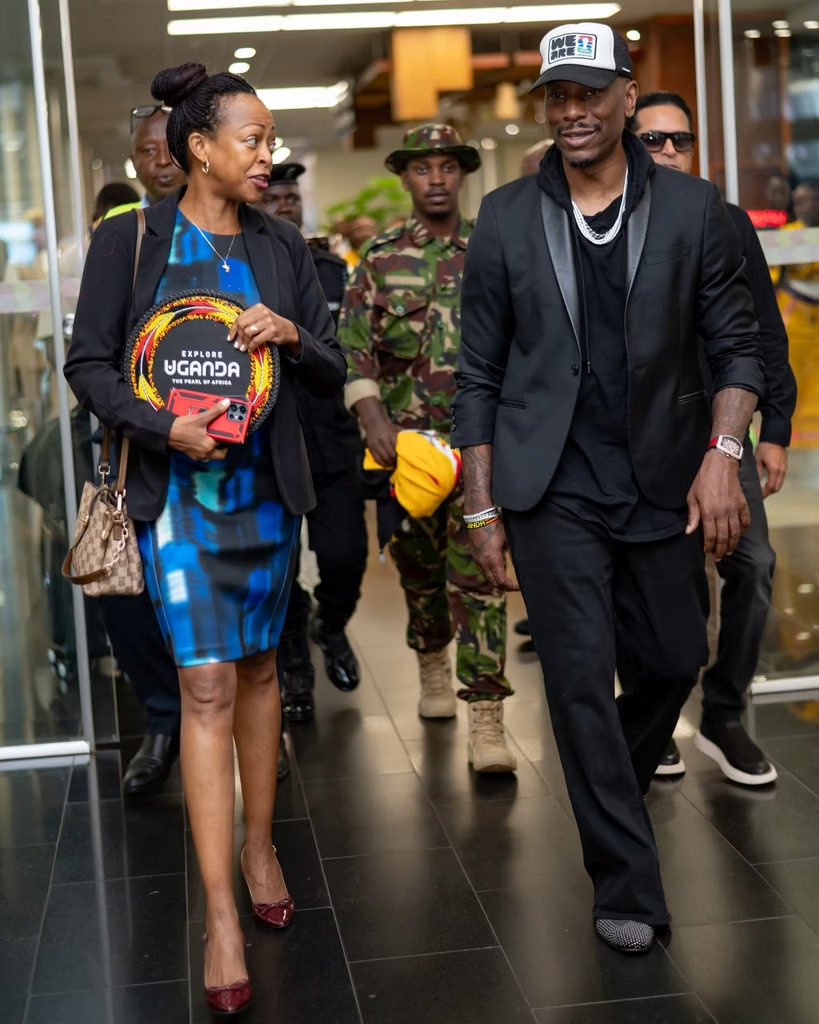
He was met at the airport by Uganda Tourism Board CEO Juliana Kaggwa and Aly Allibhai of Talent Africa Group, the agency coordinating his schedule alongside government stakeholders. It’s worth noting this wasn’t Gibson’s first time in the country either. He’d visited once before, back in 2012, and this return trip has been described, including by Gibson himself, as something closer to reconnecting with ancestral roots than a standard press junket.
The centrepiece of the visit was the official launch of Explore Uganda Coffee Tourism at the Ministry of Foreign Affairs, a joint initiative between the Uganda Tourism Board, Kampala Capital City Authority, the Ministry of Foreign Affairs, and Inspire Africa Coffee Park. The campaign has one clear goal: connect Uganda’s coffee value chain directly to its tourism offer, so visitors aren’t just drinking Ugandan coffee somewhere far away, they’re coming to Uganda to see where it’s grown, meet the farmers, and watch it get made.
What Was Discussed at State House
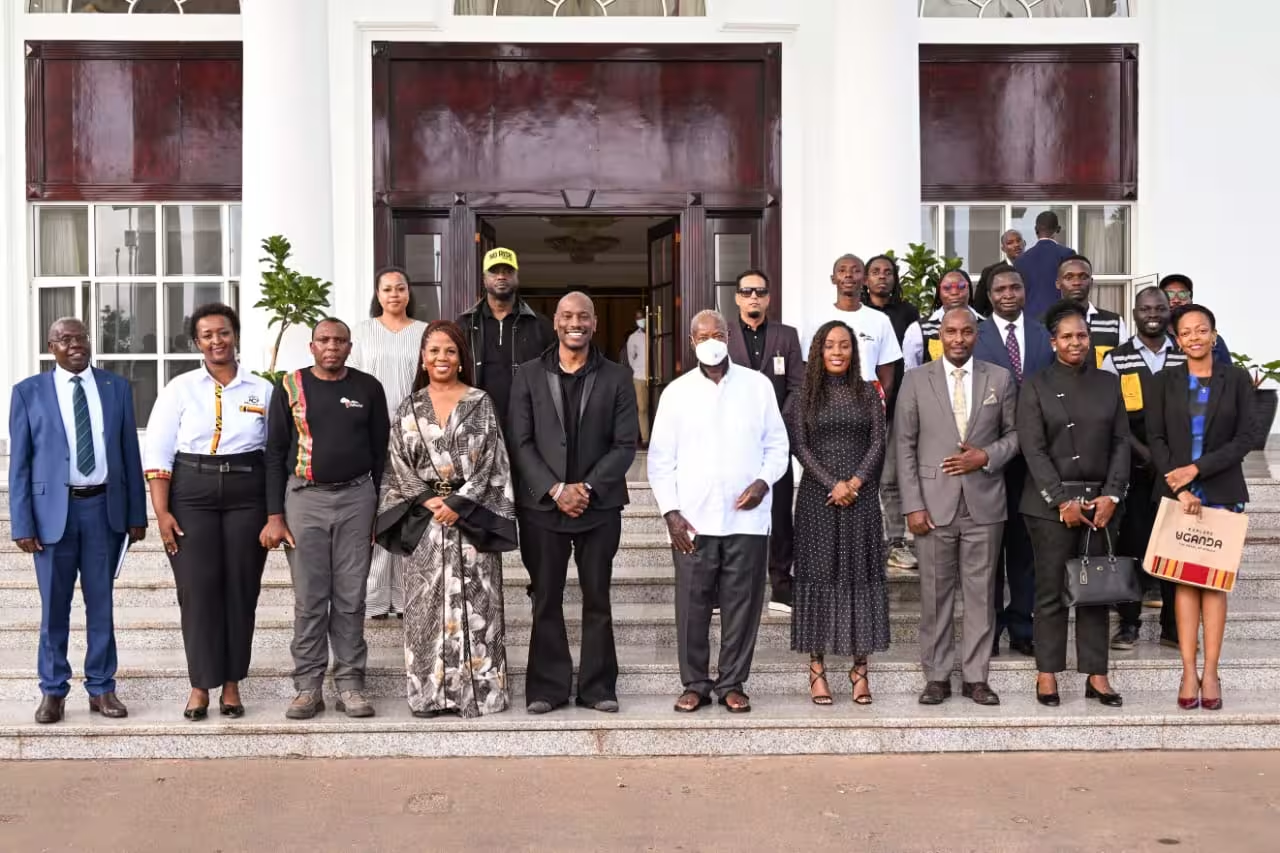
One of the more notable stops on Gibson’s itinerary was a meeting with President Yoweri Museveni at State House.
The conversation reportedly covered creative arts, tourism, investment, and the broader historical and cultural relationship between Africa and the African American community. For a visit built around coffee and tourism, a sit down at that level signals how seriously the government is treating this campaign, not as a one-off publicity moment, but as part of a wider effort to position Uganda as a destination worth international investment and attention.
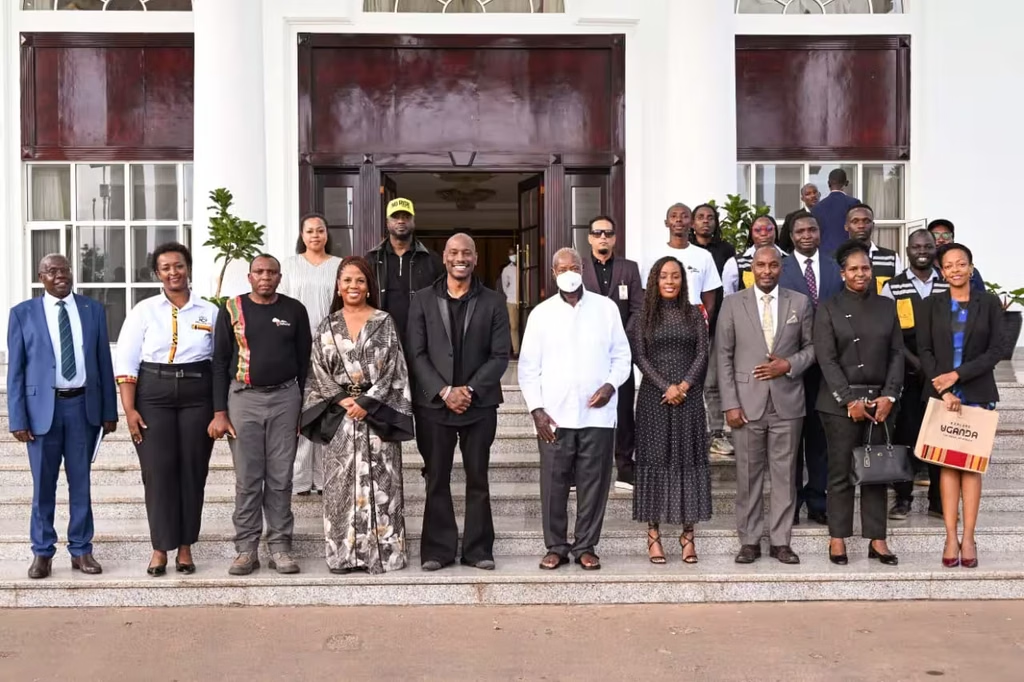
Gibson has spoken publicly about being open to future investment opportunities in Uganda. It’s worth being precise here though, nothing has actually been signed or confirmed. What exists right now is interest and conversation, not a deal. That distinction matters, and it’s one that got lost in some of the breathless coverage around his arrival.
The Man Behind the Coffee: Nelson Tugume
If Gibson is the face of this campaign, Nelson Tugume is the reason there’s a story worth telling in the first place.
Tugume is the founder and CEO of Inspire Africa Coffee Park, the company driving the value addition side of this whole push, and effectively the person heading the coffee side of the campaign that Gibson’s visit is amplifying. His pitch is built around one frustration that’s followed African coffee producers for decades: growing the beans has never been where the real money is.
Export raw green coffee beans, and someone else roasts it, brands it, packages it, and sells it for a markup Uganda never sees. Tugume’s operation is trying to flip that entirely, building an integrated model that takes coffee from cherry to finished, branded product without ever leaving the country.
What Inspire Africa Is Actually Putting on Shelves
The product range backs that ambition up, and it goes well beyond a bag of roasted beans.
There’s single origin roasted coffee, grown on Inspire Africa’s own estate in Rwashameire, Ntungamo District, using Ugandan Arabica and Robusta, sold whole bean or ground with different roast profiles depending on how you brew it.
There are drip packs, essentially portable pour-over coffee designed for people who want specialty coffee without carrying a grinder or brewing kit, aimed at hotels, offices, travel and export markets.
There are recyclable aluminium espresso capsules, compatible with Nespresso Original Line machines, made from single-origin Ugandan Robusta and sold in three intensity profiles, already being pitched to hotels, restaurants and supermarkets, with wholesale and private label options on the table too.
There’s Haraka Instant Coffee, which skips the usual spray-dried process in favour of freeze-drying, offered in Pearl and Platinum grades and aimed at everything from airlines to retail shelves to gifting.
And the product line stretches past coffee entirely. There’s an energy drink range built on cascara, the caffeine-rich fruit that surrounds the coffee bean, and a skincare brand called Ela Beauty that turns spent coffee grounds from the roastery into scrubs, soaps and body butters.
The company’s first export shipment reportedly went out to Somalia in October 2025, and it’s now eyeing China, Turkey, the United Kingdom and the United States as bigger markets. The long-term ambition, according to the company, is for Uganda to eventually stop exporting unprocessed beans altogether.
Why Turn Coffee Into a Tourism Product at All
Here’s the part that’s easy to miss in the celebrity headlines. This campaign isn’t really about Gibson. It’s about changing how a product gets consumed.
For most people who drink coffee, the bean has no story. It’s a bag on a shelf. Explore Uganda Coffee Tourism is betting that if you give people the chance to see the farm, meet the person who grew it, and understand how it gets roasted and packaged into something like a Haraka sachet or an espresso capsule, that bag of coffee stops being generic and starts being personal. People don’t just want to know what they’re drinking anymore, they want to know where it came from and who made it.
That’s not a new idea globally. Wine regions have run on exactly this model for decades. What’s new is Uganda applying it deliberately to coffee, at a moment when the country is also trying to diversify a tourism identity that’s long been built almost entirely around wildlife, primates and landscapes. Coffee gives Uganda a second story to tell, one that pulls in a different kind of traveller, the kind more interested in a farm tour and a tasting session than a safari vehicle.
Explore Uganda’s Role in All of This
It’s worth being clear about what Explore Uganda Coffee Tourism actually is, because it’s easy to assume it’s just a marketing tagline attached to Gibson’s visit.
It’s a joint initiative between the Uganda Tourism Board, Kampala Capital City Authority, the Ministry of Foreign Affairs, and Inspire Africa Coffee Park, built to formally connect Uganda’s coffee value chain to its tourism sector. In practical terms, that means positioning Kampala and the wider country as a place where visitors can engage with coffee production, culture and consumption as part of their travel experience, not just as a souvenir they pick up at the airport.
Gibson’s visit is the campaign’s most visible launch moment so far, but the initiative is bigger than one trip. Organisers behind the wider coffee push have floated a genuinely ambitious long-term target, attracting as many as one million coffee tourists to Uganda over time. Gibson is also expected to headline a Coffee Concert on October 3 at Inspire Africa Coffee Park in Ntungamo, which suggests this campaign is being built as a sustained push rather than a single news cycle.
Gibson’s visit is the campaign’s most visible launch moment so far, but the initiative is bigger than one trip. Organisers behind the wider coffee push have floated a genuinely ambitious long-term target, attracting as many as one million coffee tourists to Uganda over time. Gibson is also expected to headline a Coffee Concert on October 3 at Inspire Africa Coffee Park in Ntungamo, which suggests this campaign is being built as a sustained push rather than a single news cycle.
The Bigger Picture
Strip away the flags, the dancers, and the Fast & Furious references, and what’s actually happening here is fairly simple. Uganda is trying to capture more of the value it already produces, instead of watching it get created somewhere else.
Nelson Tugume’s Inspire Africa Coffee Park is the proof of concept, an actual operation turning raw cherry into export ready, branded products. Explore Uganda Coffee Tourism is the framework connecting that value chain to travel and experience. And Tyrese Gibson’s visit, backed by a meeting at the highest level of government, is the amplifier, giving both of those stories a level of international attention that a press release or a trade delegation never could have generated on its own.
None of that guarantees the one million coffee tourist target ever gets hit, and none of it confirms any investment beyond expressed interest so far. But it does mean Uganda’s coffee story is being told to people who weren’t listening a month ago. What happens with that attention now is the more interesting question, and probably the one worth watching past October 3.