
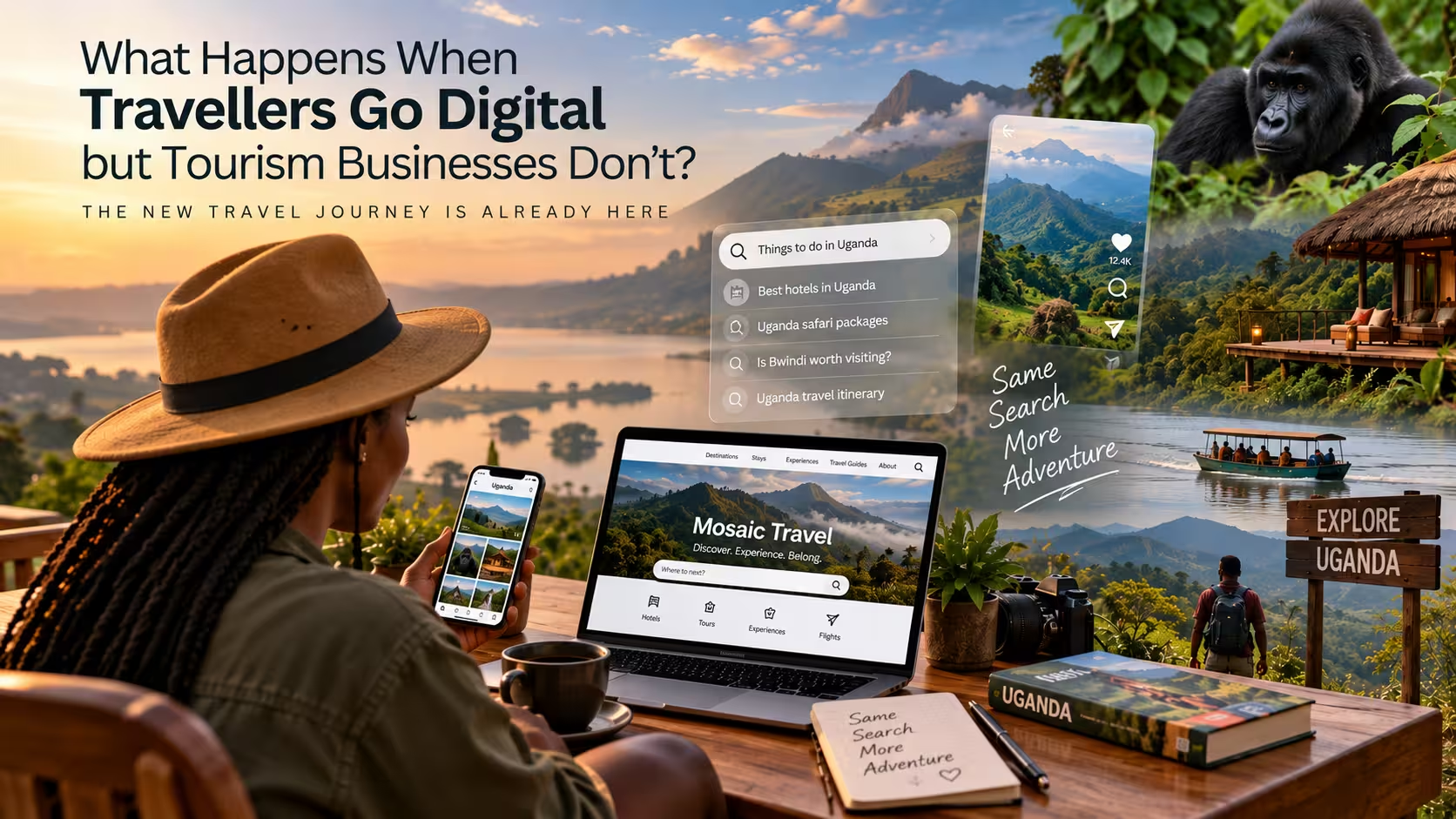
Digital tourism in Uganda has quietly become the real starting point for most trips, whether the industry has caught up to that or not. Picture someone planning a trip to Uganda right now. Chances are, they never speak to a tour operator before deciding where to go.
Uganda shows up first as a video on Instagram. Google answers whether Bwindi is worth visiting in June. An AI tool builds a five day itinerary in under a minute. From there, hotels get compared on a booking platform, reviews from strangers get read, guest photos get studied, and the whole trip gets booked from a phone, without a single phone call to anyone.
By the time a tourism business realizes that person is interested, the traveller has usually already made most of the decisions that matter.
That’s the uncomfortable part.
The State of Digital Tourism in Uganda Right Now
Tourism has traditionally run on a fairly straight line. A traveller contacts an operator, asks a few questions, gets some recommendations, books, and the trip begins.
Technology broke that sequence, and Uganda’s government isn’t pretending otherwise. This year’s Tourism Month is built entirely around digital tourism in Uganda, under the theme “Digital Agenda and Artificial Intelligence to Redesign Tourism.” It’s the same theme UN Tourism selected globally for World Tourism Day 2026. Uganda’s national celebrations land on September 27 in Mbale City, with entertainers Ssuna Ben, Spice Diana, Fik Fameica and Ykee Benda headlining alongside the Elgon region’s waterfalls, coffee tourism and cultural heritage.
What the Tourism Board Is Actually Saying
Uganda Tourism Board CEO Juliana Kagwa framed the opportunity plainly. She pointed out that the digital push gives lesser known destinations a real shot at a global audience, with the Eastern region’s mix of adventure, culture and nature well suited to that kind of promotion. Permanent Secretary Doreen Katusiime went further, making clear the goal isn’t just showing off pretty locations. Her focus is on stimulating actual visits, creating business opportunities, and connecting local communities into the tourism value chain.
That distinction matters more than it sounds.
A hotel that thinks its digital presence begins and ends with a few Facebook photos is solving a problem that stopped mattering a while ago. The real question isn’t “can people find us online” anymore. It’s “what happens once they do.” Can someone understand the offer without calling? Can they see the actual experience, not just a photo of the room? Can they compare options and find current prices? Can they send an enquiry outside business hours, book, pay, and find reliable directions to get there? Underneath all of that sits one bigger question: does what they find give them enough confidence to choose this business over the next tab in their browser?
The Booking Journey Isn’t the Business’s to Own Anymore
This is where “marketing” needs a bit of a rethink.
A hotel might assume its job is convincing someone to book a room. But by the time that traveller lands on the hotel’s website, five other questions have usually already been answered on their own. Where should I go. What is there to do. How long should I stay. Which property fits my budget. Can I trust this business.
Technology now sits in the middle of every one of those questions, well before any transaction happens. Expedia Group’s 2026 research backs this up directly, finding that travellers are leaning more on AI for discovery and planning, even as search engines and traditional booking platforms stay firmly in the mix. Here’s the twist though. That same research found travellers still put considerably more trust in established travel brands once it’s actually time to book.
Read that carefully, because it’s the whole lesson behind digital tourism in Uganda. Technology shapes the decision. Trust closes the sale. So the opportunity here was never to swap out the human side of tourism for a chatbot. It’s to make that human side easier to find, understand and trust through digital channels in the first place.
Why Digital Tourism in Uganda Is a Bigger Opportunity Than More Tourists
The timing on this conversation is good, because Uganda’s tourism numbers are already moving in the right direction.
Between January and June 2026, the country recorded 739,815 international visitors, a 3.7 percent increase on the same period the year before. That growth sits on top of an industry that’s clearly already working. The bigger opportunity now isn’t only attracting more people through the door. It’s extracting more value from the visitors already walking through it, through longer stays, more regions visited, and more experiences discovered beyond the handful of attractions everyone already knows.
Technology touches every one of those decisions.
Take a traveller who arrives in Uganda purely for the wildlife. A traditional setup sells them a safari and calls it done. A properly connected digital tourism ecosystem does more. It helps that same traveller discover a coffee experience, a cultural site, a food tour through Kampala, a hike through the Rwenzoris, or a few extra days along the Nile. The difference isn’t that Uganda suddenly has more attractions. It’s how well those attractions are connected to the moment a traveller is actually deciding what to do next.
Where AI Fits Into Uganda’s Digital Tourism Push
AI in tourism tends to get discussed like every hotel now needs to build a sophisticated robot or replace its front desk team. That’s probably the wrong starting point entirely.
The more useful opportunity is much simpler. AI can help tourism businesses understand what different travellers actually want, then respond accordingly. A couple planning a luxury honeymoon shouldn’t get the same recommendations as a backpacker, a family with three kids, or someone in town for a conference. Used well, the technology organizes information, personalizes suggestions, handles routine questions, and makes an overwhelming amount of information easier to actually navigate.
Travellers globally are already there. Booking.com’s 2025 global research found 89 percent of respondents wanted to use AI in future travel planning, and 67 percent already had, most commonly for researching destinations and finding local experiences.
But there’s a real warning buried in all of this. AI doesn’t automatically make tourism better. Bad information delivered faster is still bad information. A chatbot that confidently recommends a closed attraction, or hands out outdated hotel rates, can wreck trust faster than a badly maintained website ever could. Getting this right takes accurate data, responsible AI use, solid digital infrastructure, and people who know how to manage these systems, all areas Uganda’s wider AI readiness work has already flagged as needing attention.
Small Doesn’t Mean Left Behind
There’s a common assumption worth pushing back on here. Going digital doesn’t mean small tourism businesses suddenly need to outspend multinational hotel chains on technology.
In some cases, it’s genuinely the opposite. A small lodge with sharp photography, accurate information, fast responses and a simple booking process can deliver a better digital experience than a much bigger property running on brand name alone. The same logic applies to tour operators, restaurants, and community tourism ventures.
The competitive edge can come down to something almost embarrassingly basic. Being easier to understand. Trusting the information you’re given. Buying without friction.
That sounds simple. It isn’t, in practice, because it means businesses have to stop treating digital channels as a marketing task bolted onto the “real” business. They need to become part of the tourism product itself.
The Real Risk Isn’t AI, It’s Becoming Irrelevant
Uganda’s Tourism Month theme is bigger than an announcement about artificial intelligence. It’s a warning about where the traveller has already gone.
The country has extraordinary wildlife, mountains, lakes, food, culture, coffee and hospitality, and none of that is in question. What’s changed is that travellers increasingly meet those things through a screen long before they meet them in person. A search result might be the first real impression. So might a photograph, a TikTok video, or a stranger’s review. So might an AI generated itinerary, a hotel website, or a booking platform.
Which means the digital layer wrapped around Uganda’s tourism products has quietly become part of the destination itself.
That shifts the responsibility across the whole chain. Government needs to make destination information more accessible and joined up. Tourism boards need to think past promotional campaigns and invest in digital experiences that are actually useful. Hotels and lodges need to make their products easier to find and book. Smaller businesses need practical digital tools that let them participate, rather than get pushed further to the edges.
Uganda has already started laying pieces of this down. The Ministry’s tourism information platform is one example, built to collect and present tourism data in a way that’s actually useful for decision making. What’s still unclear is whether the rest of the industry moves with it, or waits to be dragged along.
The traveller certainly isn’t waiting for the tourism industry to catch up.
They’re already there.
What This Means for Tourism Businesses in Uganda
If you run a hotel, lodge, restaurant, tour company or experience, the takeaway isn’t that you suddenly need an expensive AI system bolted onto your operations.
The customer journey has already moved, whether your business has or not. That means showing up where decisions are actually being made, and answering the real questions travellers ask before they even reach out. It means building enough trust to cut through the uncertainty of booking somewhere unfamiliar, and making the jump from discovery to booking as frictionless as possible.
Getting digital tourism in Uganda right, at the business level, is what turns that shift from a threat into an advantage.
How Mosaic Marketing Collective Can Help
At Mosaic Marketing Collective, we work with hotels, lodges, tour operators and tourism boards trying to close exactly this gap, between how travellers actually make decisions today and how their digital presence currently performs.
That includes content and digital strategy built around real traveller behaviour, website and booking journey audits, destination positioning, and practical digital tools that help smaller tourism businesses compete on trust and clarity rather than budget alone.
The businesses that win the next few years of digital tourism in Uganda won’t necessarily be the biggest.
They’ll be the ones easiest to find, easiest to trust, and easiest to book with.