
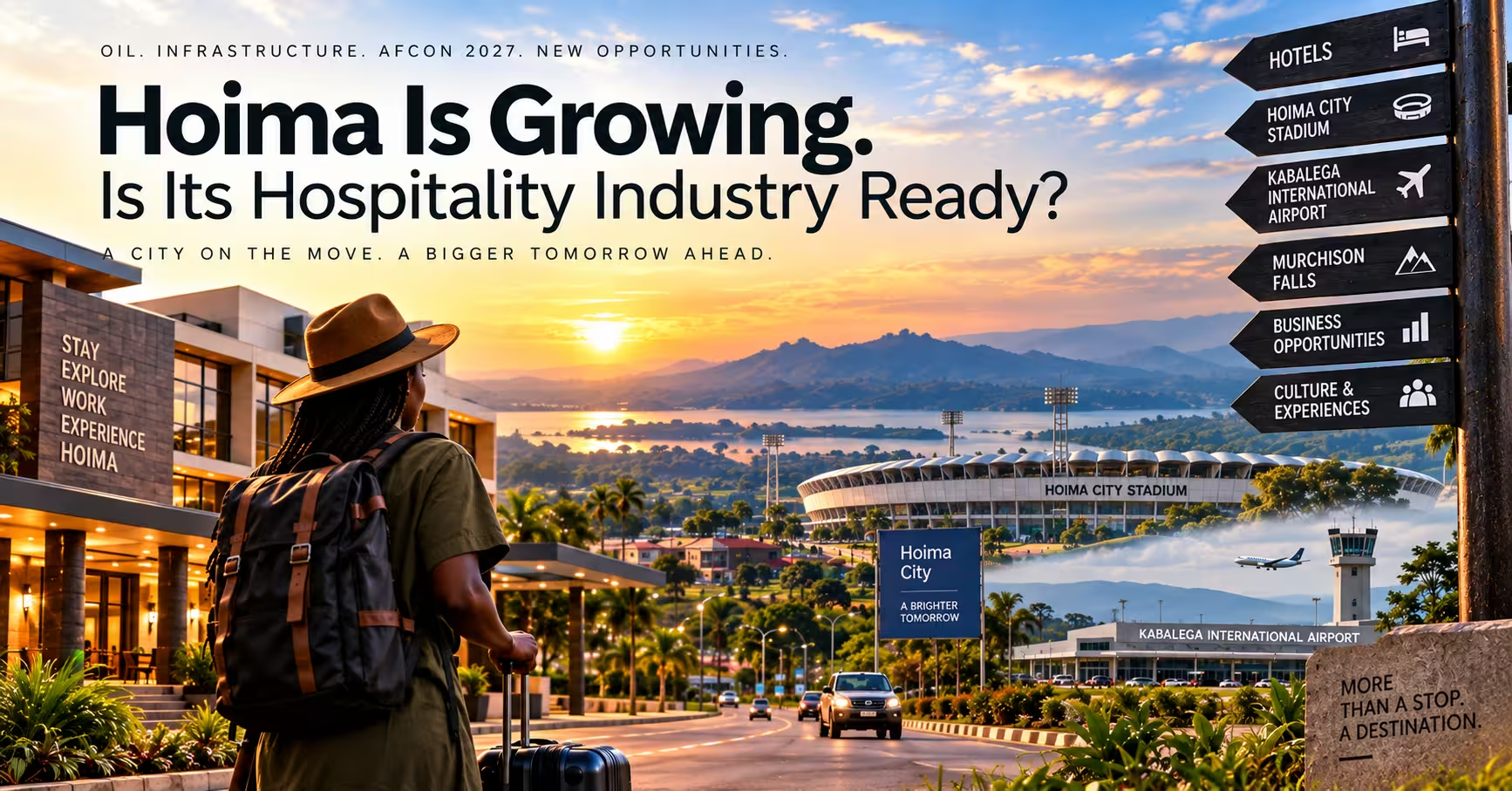
The Hoima hospitality industry used to be a story about potential. Oil discoveries had changed the conversation. Investors were arriving. Crews were building new roads, and Kabalega International Airport was taking shape. Hotels followed, on the fairly simple assumption that more economic activity would eventually mean more guests.
That stage is already behind Hoima.
The question now isn’t whether the city will attract more visitors. It’s whether its hospitality industry can actually absorb the people, expectations and spending arriving alongside that growth.
That question has gotten harder to ignore with Uganda preparing to host the 2027 Africa Cup of Nations. Hoima will host matches at the new Hoima City Stadium, and the city and neighbouring Masindi are also building training facilities. Hotels across Bunyoro are racing to expand and upgrade before the tournament arrives.
AFCON is only part of the story though.
The Hoima Hospitality Industry Faces Its First Real Test Before AFCON Arrives
One of the clearest signs that demand is already shifting is that Hoima’s accommodation challenge is showing up well before the tournament itself.
In August, sports officials raised concerns about both the quality and capacity of hotels in the region. According to Nile Post, officials have earmarked ten hotels in Bunyoro for AFCON, seven in Hoima and three in Masindi. Officials said only around 200 of the required 20,000 rooms currently meet the expected standard.
Whether that entire room requirement materialises exactly as projected matters less than what the numbers reveal. Hoima’s hospitality infrastructure hasn’t caught up to the level the city now needs to operate at.
Smaller Events Are Already Exposing the Gap
That pressure is visible even during far smaller events. When the National Basketball League finals were held at Hoima City Arena, officials said hotels sold out, despite the event attracting nowhere near the crowds an AFCON tournament would bring. Some recent government delegations have reportedly had to stay outside Hoima entirely because suitable accommodation wasn’t available.
That’s a useful warning. The city doesn’t have to wait for thousands of international football fans to arrive before finding out whether its hospitality system actually works. Hoima is running that test right now.
The Hotels Are Investing, But This Is Bigger Than More Rooms
There’s already significant investment underway. Edmara Hotel in Hoima is reportedly about 80 percent complete, with plans to finish construction by December 2026. Hoima Resort Hotel has upgraded to four star status and now offers accommodation that meets AFCON requirements. Albertine Palace is expanding its international standard rooms from 78 to 100, while Kabalega Resort Hotels is increasing its combined Hoima and Masindi capacity from 102 rooms to 259.
Government has committed real money behind this too. In March, government pledged Shs30 billion to help Bunyoro hoteliers upgrade their facilities ahead of AFCON. Subsequent funding plans have added Shs101.1 billion in credit support for hotel upgrades across Hoima and Masindi.
On paper, this looks like a straightforward fix: solve a room shortage by building more rooms. That’s only half the problem.
A hotel room isn’t the same thing as a hospitality product. A visitor doesn’t arrive in Hoima simply needing four walls and a bed. They need reliable internet, transport, food, and clean, consistent service. They need staff who understand international guests, and somewhere to go once the meeting, match or business engagement ends. The more Hoima grows, the more those details start to matter.
The Real Competition May Be Service, Not Accommodation
This is where the Hoima hospitality industry has a chance to think beyond construction.
Several hotels are already investing in staff training and guest experience. Albertine Palace, for instance, says it’s upgrading rooms and restaurant services while training staff in customer care, hygiene and hospitality. Hoima Resort is even considering recruiting hospitality professionals from Kenya and Rwanda who speak Swahili and French, specifically to serve international visitors better.
That matters because Hoima’s next customer won’t necessarily look like the customer the city served ten years ago. The oil and gas economy brings business travellers, contractors, consultants and technical teams. AFCON brings football supporters, officials, media and international visitors. The airport creates easier access for travellers generally, and Bunyoro’s own cultural and tourism assets could encourage many of them to stay longer than planned.
Each group arrives with different expectations. A hotel that understands that difference has a far better shot at building repeat business than one that simply bolts on another twenty rooms.
The Hoima Hospitality Industry Can’t Be Built Around AFCON Alone
There’s always a temptation, whenever a major event arrives, to treat it as the entire business case. That would be a mistake here.
AFCON will come and go, but the stadium, the roads, the airport infrastructure and the hotels will all stay behind. What matters is what happens after the tournament leaves town.
This is where Hoima’s oil and gas economy becomes particularly important. The city has spent years positioning itself around the Albertine region’s economic activity. Yet hotel operators have previously complained that anticipated oil and gas demand hasn’t always translated into hotel occupancy, since some companies house staff in camps or accommodate key personnel elsewhere. Hotel owners have also pointed to standards that are genuinely difficult for existing properties to meet.
That history should matter to investors. Building a hotel because you expect demand is one thing. Building a hotel that understands exactly who will stay there, and why, is a different exercise entirely. The strongest businesses will need to think beyond whatever event is next on the calendar.
The Bigger Opportunity Is Making Hoima a Place People Stay
This may be the most important question facing the city’s tourism and hospitality sector. Can Hoima become more than a place people travel to purely because they have business there?
Bunyoro has culture, food, history and access to major tourism attractions. Hotels and tour operators in the region are already exploring ways to connect accommodation with visits to places like Murchison Falls National Park, Nile cruises and cultural experiences.
That creates a far more interesting proposition. A business traveller could extend a work trip. A football supporter could arrive early and explore. A family could combine a match with a regional holiday, and an international visitor could use Hoima as a base for exploring western Uganda more broadly.
That’s where hospitality starts becoming tourism, and the distinction matters. A city can have hundreds of hotel rooms and still fail to become a destination. Hotels provide somewhere to sleep. A destination gives people a reason to stay.
What Comes Next for the Hoima Hospitality Industry
Hoima is clearly moving. The stadium is changing the city’s profile. Oil and gas continues shaping investment. Infrastructure is improving. Hotel operators are expanding, government is backing hospitality upgrades financially, and regional businesses are preparing for a new wave of visitors.
Growth like that creates its own test though. Can the city’s hospitality businesses deliver consistently? Can they attract and retain skilled staff? Can they meet international expectations without losing what makes Bunyoro distinct? Can they turn short-term visitors into longer-stay tourists, and build businesses that stay viable long after AFCON ends?
Perhaps most importantly, can the Hoima hospitality industry grow alongside the city, instead of just reacting to each new wave of demand as it arrives?
The opportunity here is significant. But opportunity alone doesn’t create a successful hospitality market. Readiness does.
For hotels, lodges, restaurants and tourism businesses in Hoima, that means thinking past the room, the event and the next booking. It means understanding who’s actually coming, what they expect, what else they can experience nearby, and what would make them choose to stay a little longer.
Building for What’s Next
Hoima is entering a different kind of hospitality market. The businesses that thrive will need more than rooms and good service. They will need to understand how people discover places, what influences their decisions and what makes them choose one business over another.
That is where Mosaic Marketing Collective comes in.
We help hotels, lodges, restaurants and tourism businesses turn what they offer into something people can discover, understand and choose, through strategy, content, digital campaigns and destination storytelling.
Because being ready for the next wave of visitors isn’t just about having somewhere for them to stay.
It’s about giving them a reason to choose you.